The 2026 edition of the Global Artificial Intelligence (AI) Summit, held in New Delhi from February 16-21, marked a definitive shift in the global tech hierarchy. With the previous locations bring in the United Kingdom, South Korea, and Paris, the decision to convene in India signals a strategic pivot toward the Global South. By tapping into the vast user bases and resources of this emerging market, the summit moved beyond theoretical risks toward a framework built on three pillars: People, Planet, and Progress. While the emphasis on cultural diversity and inclusive growth marks a critical inflection point, the corporate world now confronts the practical implications of this state-led approach.
The MANAV Framework: Compliance as Infrastructure
A central outcome of the summit was the introduction of the MANAV framework by the Indian Prime Minister Narendra Modi. Standing for Moral, Accountable, National, Accessible, and Valid AI, MANAV represents a shift from viewing AI as a peripheral tool to treating it as foundational national infrastructure.
For the corporate sector, this signals that robust oversight mechanisms have become the foundation rather than being optional. Global firms now face a dual challenge where they must continue to push the boundaries of advanced technology while ensuring total alignment with layered compliance mechanisms implemented by both governments and institutional watchdogs.
Ending the “Black Box” Immunity
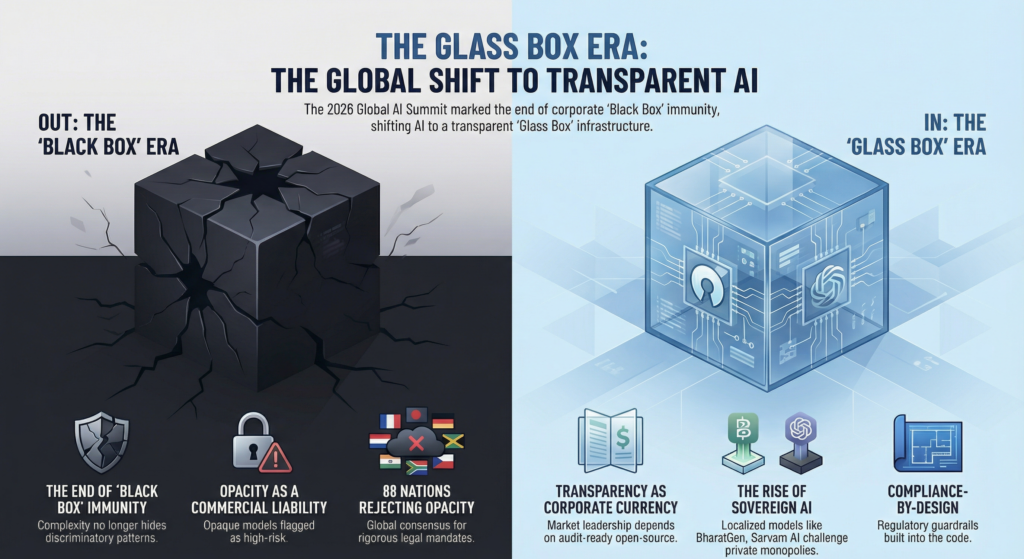
Historically, corporates have operated under a “black box” immunity, utilizing the inherent complexity of AI and Machine Learning to defer accountability. This lack of interpretability has long served as a barrier actively hiding discriminatory patterns, errors, biases, and leading to suboptimal and often unethical outcomes.
The New Delhi Summit effectively signaled the end of this opacity. The push to turn transparency into a mandate means that the “Black Box” models are now a liability. Corporations must re-calibrate their Research & Development to balance high-speed innovation with the rigorous interpretability requirements now demanded by global regulators.
Rise of Sovereign AI
The unveiling of three indigenous Indian models such as Sarvam AI, Varchana TTS, and BharatGen’s Param2 has positioned India as a creator and not just consumer of Large Language Models (LLMs). This move forces re-engineering of proprietary stacks to ensure interoperability with localized, multilingual models.
By integrating AI into its Digital Public Infrastructure (DPI), India is challenging the Western conception of AI as a private, profit-driven enterprise tool. This creates a critical corporate risk where state backed projects may receive preferential access to the Indian market, while the principle of “National Sovereignty” (whose data, his right) mandates that corporates bear the structural costs of building local computing power and core AI capabilities.
Compliance Mandate: From Hurdle to Architecture
The Summit ends the era of “voluntary’ AI ethic and attempts to replace it with a rigorous techno-legal compliance mandate. Corporates must now view compliance as a core architectural requirement rather than a post-development hurdle. Any product that fails the test of lawfulness and verifiability will become a commercial liability.
This “compliance moat” favors incumbents with deep regulatory pockets, but it also forces a shift toward Open Ecosystems. By adopting open-source and verifiable foundations, firms can reduce dependency on single global providers and ensure their internal systems are “audit-ready” by default. Those who fail to pivot toward this framework risk being locked out of India’s broader digital ecosystem.
End Note:Navigating the Glass Box
The New Delhi Summit marks the definitive end of the “Black Box” era and the birth of what will probably be the “Glass Box” era. This era essentially represents a landscape where AI must be transparent, verifiable, and lawful by design. For the modern corporation, the message is that the ability to navigate these regulatory guardrails is now just as important as the code itself. In this new era, market leadership will not be defined by the sophistication of a firm’s algorithms, but by the integrity and transparency of the systems that govern them.